Sunday, April 27, 2014

Class #7: The System (Art History Lesson)

1. Describe each work in brief.


2. Give your best guess as to the audience of each work.


3. Describe what ideas each work it attempting to bear witness to.

4. Describe the differences between the respective works' representations of beauty.

5. Do you think either of the artists knew about the others' art-making tradition? Why?

6. Do you think the mainstream (European) work deserves its place in the mainstream story of art? Why?

7. Do you think the non-mainstream (non-European) work deserves a place in the mainstream story? Why?


ART WORK#1


1. The Abduction of Rebecca(1846) 

Artist: Eugène Delacroix(French, Charenton-Saint-Maurice 1798–1863 Paris)

This painting shows a scene from Ivanhoe, the Jewish heroine Rebecca, who was confined in the castle of Front de Boeuf(seen in flames) is carried off by two Saracen slaves commanded by the Christian Knight Bois-Guilbert. This painting depicts the crowded space, the alertness on the slaves and the contortion depicts the dramatic intensity of the abduction. In contrary, Rebecca is the only one in the whole painting that is calm and composed. 

2. The audience of the first painting would be for the European people specifically the french people as this could be more relatable to them. 

3. This painting is bearing witness to the abduction of Rebecca and her courage. 

4. Delacroix is representing the beauty of the painting through the different colors,movements that showed the complexity and the emotions of this art. 

5. I don't think that Delacroix knew of  Shaykh Muhammad Amir as they live in different  parts of the world and also Delacroix is a romantic artist. He was an impressionist who was inspired by Shakespeare and other french romantic artist. 

6. I think European Art deserves its place in the mainstream story of Art because these artwork were made in different periods with different style in different places and some artwork, though were made in same period but have different styles. The variety, evolution of these artwork gives us an knowledge on the abstractness and the expression of these artwork.


ART WORK#2
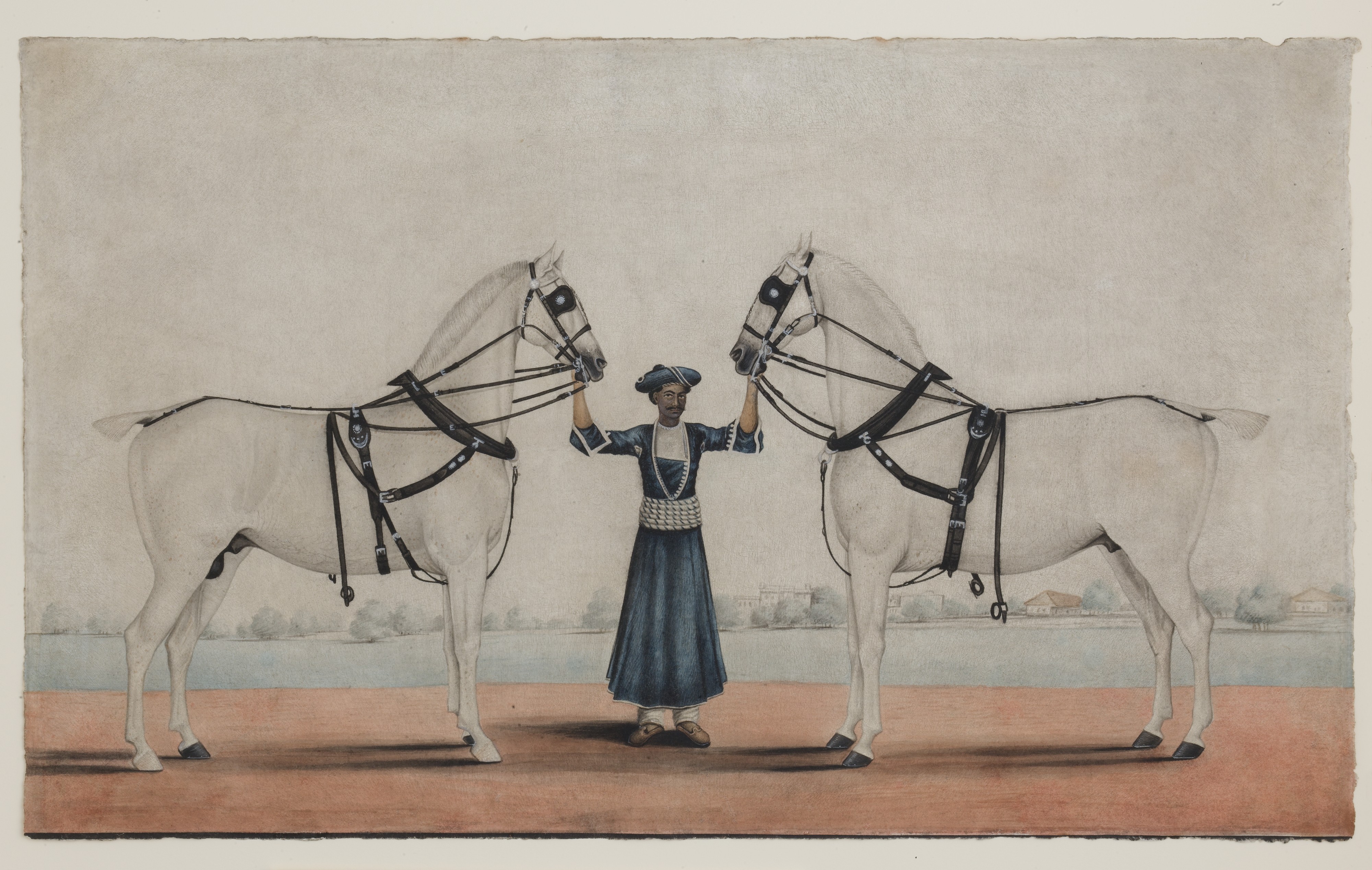


1. A Syce Holding Two Carriage Horses (1845)

Painting attributed to Shaykh Muhammad Amir of Karraya (active 1830s–40s)


This a near mirror image of an Indian groom with almost identical horses. The prospect of symmetry is provoked by the slight difference in the sizes, proportions and the slight variation in the dress and the posture of the painting. The colors are very restricted in the painting but however, the painting was beautifully drawn to show the culture of Indian also the low horizon line makes the painting more majestic. 


2. The audience of the painting would be the South Asian people specifically the Indian
people. 

3.  The artist is attempting to bear witness to the Indian culture as well as the symmetry of
the painting. 

4. Amir's representation of the beauty of this painting is very different from Delacroix as he is trying to depict the simplicity of the painting with just few colors of the paint as well as the almost symmetrical image of the Indian groom and the horses.  


5. Amir probably was aware of Delacroix art-making tradition as his art making process reflects the Indian culture of free expression as well as the water color style which is massively influenced by the European Art. 


6. I think non-European work deserves a place in the mainstream story as these artwork also depicts the different forms of art in different periods and their cultures. Such culture and the beauty of the non-European Artwork must be appreciated and celebrated the same way an European art work is. 

Tuesday, April 22, 2014

Cooking up a Story: The food Recipe

Shabalak 

This is the recipe.

Ingredients: 
  • Ground Beef (6 people portion)
  • 4-5 washed Scallion
  • Dough ( flour with water kneaded together)
  • 2 table spoon of salt
  • 1 onion.
  • Oil
Direction:

The dough needs to be made in small balls of dough.


The scallion must be cut into small pieces with the onions cut into small pieces and mixed with ground beef.


The small dough needs to be flattened by a rolling pin.


Put the mixed ground beef in the flattened 
dough.


Cover the meat from the other side of flattened dough. Fold the one side of the dough over the other.  Then using a fork, flattened the edges so that the meat does not come out.


Using our hand, keep folding the edges of the dough.


While making it, the oil needs to be heated up. After the oil is hot, put the shabalak in to fry it. After 5 to 6 minutes, take out the fried Shabalak. Shabalak is done. 


Dinner Time:


The making of Shabalak depicts the culture of tibetan as it is our traditional food. While making this food, we all make it together as this takes around an hour or so. The process of making it give us the time to spend it with our family. This dish is one of the my favorite tibetan dish of all time. Shabalak and Momo is one of the most common dish as an authentic tibetan food. When i took my friends with different cultural background to a tibetan restaurant, they mostly enjoyed Shabalak the most because they said " its juicy from the inside and the fried outer skin makes it more delicious."


Class #6 Followup

1. How does Yves Klein’s blue cocktail relate to the metaphoric nature of food to transmit ideas?

During his 1958 The Specialization of Sensibility in the Raw Material State of Stabilized PictorialSensibility (the Void ) exhibition where more than 2,500 persians showed up for his exhibition. The exhibition was an empty gallery with walls painted white. The 
exterior window was painted blue with the entrance lobby framed with blue curtain. 
However, the guest were served with blue cocktails which was made of Cointreau,gin 
and methylene blue (the blue cocktail). Through the blue cocktail,Klein exerted the 
control over the guest body as the cocktail dyed their urine blue. This relates to the 
metaphoric nature of food to transmit ideas as he wanted the people to see the 
transmission of blue colors through the process of drinking and urinating later to 
discover how he controlled the flow of substance out of the body through the process of 
blue cocktail.  

2. What does Andy Warhol's Campbell's Soup piece say about post-WWII America's relationship to food?

Andy Warhol's Campbell's Soup piece depicts the industrialization during post World 
War 2 has drastically changed the relationship of Americans with food. The process of 
agriculture and cooking became less common where the instant food such as Campbell's 
Soup have become a norm. Andy Warhol is trying to push towards the mechanical 
appearance of America in the form of food.

3. What do you think about the Bread & Puppet theatre idea that baking your own bread is a political act?

I feel that the Bread & Puppet theater idea that baking your bread is a political act 
because baking your own bread helps to empower one self socially and politically. The 
Theater performs and highlighted on the issues of social changes, the trends of society 
and politics. Schumann then baked their own bread in the oven and gave it to the 
attendee for free. The sharing of bread makes the people connected with one another.

4. Compare Judy Chicago's "Dinner Party" to Leonardo da Vinci's "Last Supper".

The Judy Chicago's "Dinner Party" is different from Leonardo da Vinci's "Last Supper" as 
the Judy Chicago's Painting depicts the dinner place setting where thirty nine important 
women in real life or fictional character in the history will be sitting together to honor 
their contributions as most of the time, the women's contribution were ignored, never 
acknowledged or were overshadowed by the men's contribution. The painting doesn't 
have the women's sitting rather it is just a dinner setting. However, the Leonardo da 
Vinci's " Last Supper" was to capture the moment when Christ tells his Apostles that 
one of them will betray him at the institution of Eucharist. This painting bring the 
different emotions between the Apostles with Christ in the middle.

5. Describe how  Rirkrit Tiravanija's, Theaster Gates', or Michael Rackowitz's projects take advantage of the social aspect of meal-sharing to generate ideas and discussions. 

Rirkrit Tiravanija's "Pad Thai" where he sets up a cooking place in the gallery where 
he cooks Pad Thai, his traditional thai food and the visitors try the food which opens up 
discussions on the culture of thai and the food by the visitors from different culture. It 
also depicts the culture of the Artist. 
Theaster Gate's "Soul food Dinner" is a Sunday Dinner where soul food can be eaten. 
Different people from different cultural background come together to eat where they 
discuss social issues such as race and inequality while sharing the food and their 
memories while questioning and celebrating the complexity of the different flavors of 
the soul food. 
Micheal Rakowitz "Enemy Kitchen" is set up in response to the United States invasion of 
Iraq. Since he was descend of Iraqi Jewish , they serve their traditional food to open 
discussion of the War, U.S.- Middle East relation and how cultures influence one another. 
Through these artist, it depicts that sharing meals helps to open up discussions on different social and cultural aspect of the artist as well as generate ideas.  

6. What do you think about Daniel Bozhkov's "Befriend the Bacteria" project? Why did he create such a bizarre foodstuff? What should our relationship be to this yogurt and how does it relate to the history of the "self-portrait" and the idea of the artist 'bearing witness'?

Daniel Bozhkov's "Befriend the Bacteria" project is weird. He created such a bizarre 
foodstuff because he wanted make an organic yogurt with human DNA. The bacteria 
culture modified with his DNA would produce a yogurt and he packaged it in marketable 
containers with his face on it "Human DNA Reinforced". Our relationship to the yogurt
is our awareness to the human cloning in the form of yogurt. It relates to the history of
self portrait and the idea of "bearing witness" as his DNA and the picture of his face on 
the container bear witness to his existence.


Sunday, April 6, 2014

HW# 5

1. Class #5 Fieldtrip Response: Post an image of the second work that you studied at MOMA and also your answers  to the 13 categories of content for this art object in a blog post. 


  1. Willam de kooning is not trying to pursue a picture. This just an abstract drawing. 
  2. There is no specific title for the painting. It is just called the "painting".
  3. The genre of the artwork shows depicts that this an abstract painting with no focal point. There is no specific image unlike the usual European painting.
  4. The material of the artwork from which it was made of is oil and enamel sign paint. 
  5. The scale of the artwork is a medium size, not too large and not too small. However, since the figures were transferred from tracing papers. In the painting, the paints are dripping. The scale is 42 5/8 x 56 1/8" (108.3 x 142.5 cm). 
  6. The duration of the artwork has been 66 years as it was made in 1948. The artwork still looks the same, well preserved.   
  7. The context arriving from the artwork is expressionist from abstract artwork. 
  8. The content relating to art history is the pure abstract art.
  9. The colors ( black and white) make it the painting more ambiguous, not knowing what is figure and what is ground. . 
  10. There is no specific iconic tradition.
  11. The formal properties of the work make the artwork so simple yet complicated and very abstract.
  12. The irony of the artwork is that Kooning has said "even abstract shapes must have a likeness" but the simple colors of black and white makes it so simple yet complicated that there is no likeness rather complication. 
  13. I did not really like this artwork because I felt the artwork is very freely done with loose figuration that was hard to understand. The abstract nature of this artwork is very complicated when I kept on looking at it. 

2. Class #5 Lecture: Watch the lecture below and the linked video interview with Janine Antoni, then answer the following questions in a blog post.

a. Describe the process of Antoni's rope-making piece, Moor (2001), that is discussed at length in the video. What is this piece about?

The process of Antoni's rope-making piece is that she put in different material by different people merging it together to make a rope. This piece is about merging the lives together of the people in her life by merging the materials together. It is telling a story of the people being held in the material. 

b. The process of rope-tying that she learned is very different from the process of action painting.How is this method particularly appropriate to the meaning that she wants to get across?

The rope tying that she learned is very different from the process of action painting as the rope is tied together and connected with different clothing of the people in her life. She wanted to hold the experiences and memories of the person in her life by tying the materials of the person together which influences her to be who she is. The method is appropriate as the different colors of the material represent different people and different events in her life which is merged together.

c. Do you think a person completely ignorant of Antoni's work, someone with no verbal information to assist them, would understand the meaning of Moor ? What would they get? What would they miss?

I think a person completely ignorant of Antoni's work would not be able understand the concept of " Moor" completely. They would probably get that the different colors of the materials on the rope would depict different people and different event. But they would probably miss why she wanted to merge the different materials of the different people in her life together. 

3. HW:


Think about skills that you know, that are important to your family, your traditions, or that you pride yourself in knowing.

Describe in a paragraph-long blog post how you would adapt one of those skills to make an artwork that communicates something important about you, your family, your culture, or some important knowledge about yourself. Think about what materials you would use, the location where you would display the artwork, the group of people you would ask to help in the process, if any. Let yourself think about this problem throughout the week. When your write,be detailed about the how you learned the skill, why it's meaningful to you, the steps in the process, and how you would incorporate other meaning into this process, and what it ultimately is produced as a result of this process.


I love to cook so it could be my passion rather than skill. The skill I pride myself in knowing is making tibetan food. I have learned it from my mom. I can make traditional tibetan food called Shabalak. The Shabalak looks like a beef patties but it taste very juicy and has the strong beefy taste. When you are making a shabalak, you need dough, ground beef, scallion, some garlic and salt. The dough needs to be kneaded together into one large ball. Then, cut the large ball into small parts and roll it into a ball. Cut the scallion and garlic into small pieces and mix it together with the ground beef. Put some salt on the mixture of the ground beef. Since the filling is already made, the small dough must be flattened out. Then, using a rolling pin, press the flattened dough to make the skin not too thin. It has to be thick enough to hold the filling. After that, the egdes of the dough with the filling, needs to be flattened out together to avoid bursting it open when frying in the hot oil. Then, put the dough into the hot oil and fry it for 10 minutes. Tadaa... Shabalak is ready. Making such food, takes time and need patience as you would need an hour to do so. Also, when I make it at my house, I make it together with my family. In this busy New York, where everyone is constantly busy, making this kind of food, gives our family our own family time, where we share our feeling, laugh and just enjoy being a family.


I would like to make an artwork of a tibetan family in our traditional dress, laughing together and making shabalak together. I would like to display the artwork in Jackson Height where many tibetans live. I wanted to remind the tibetans youth, the importance of our culture, family as many youths are so busy following the American culture that they neglect the importance of our tibetan culture and the warmth of the family.