Sunday, March 30, 2014

HW#4: Translation

Pick one of these artists and answer these questions in a substantial paragraph in your own words.

1. Describe the artist's process.
2. What information is the artist trying to translate through this process.
3. What other information is (intentionally or unintentionally) captured in the finished visual/audio work.
4. Is the final outcome of the process interesting to you? Why?


Rashaad Newsome 

1. The artist used the process of vogue dancing : hands, spins, catwalk, duckwalk and dips to depicts the line drawing. Newsome dressed all the dancers in distinct colors of clothing or hair to depicts the different colors of line drawing through the performance of vogue dancing using motion tracking software. For the music, he starts of with Stephanos Koroneos, an amazing opera singer and then uses flute, violin, electric guitar, saxophone and drums throughout the performance with Kevin Jz Prodigy who is a very prominent figure in vogue community. 

2. Newsome is trying to translate the process of vogue dancing through the line drawing using the motion tracking software.

3. The audio/visual works have shows that though the vogue dancing, opera singing and instruments are all battling for their own distinct voice, looking very unharmonious yet the rhythmic structure make it all harmonious make it visually artistic. In addition, it captures the stigma of vogue dancing that it was always seen from singers like madonna that people thinks that it was originated from them however the truth is it was the part of the society for a long time way before them. 

4. The final outcome was interesting to me because the line drawing was fascinating as all the movement of the performers were captured drastically with the rhythmic audio on the background. The harmonious performance was interesting. 


2. HW Assignment: Process Drawing

Now YOU are going to make a drawing that is determined by some kind of process of translation.

Think of it as creating simple ( or complicated) rules for yourself that will produce a visual record.


Materials used: 


 Translation of my hand movement: 


FINAL Outcome of my hand movement using paint brush and paint.


Sunday, March 23, 2014

HW # 3


1. How do Mutu's Human/insect/machine-like distortions of the body relate to conventional notions of female 
beauty?


The conventional notions of female beauty has changes over time. Mutu's human/insect/machine-like distortions of the body relates to the conventional notions of the female beauty as her works expresses the powers of women in a unique way through collages, paintings on a female body. Her artistic way of showing a female beauty is that she use different elements in her work mostly provocative collages depicting female body with part humans, animals, plant and machines that are powerfully attractive and fascinating which defy the norm of easy identification. Through such identification, the female beauty is portrayed with empowerment. The distortions of the body shows the imperfections in the female beauty and the acceptance of such imperfections makes the female more fierce and strong. 

 2. Describe how one of her works functions formally. How is the work beautiful and how is it ugly?


This work is beautiful as it shows the cultural displacement as well as the transculturation (merging and converging of cultures). The facial features were drawn using bits of many ethnicities to make it hard to identify her race. Also, the baldness depicts her alien quality as usually women are expressed through their hair. The body of the women is hard to recognize as the different colors of the skin could be her skin or a body suit or both. The mushrooms on the ground who has no roots, need no sunlight, neither categorize as plants are depicted as immigrants who has to leave their nation to settle in the country. The bodiless bald eagle depicts United States. This artwork depicts the multi-culture of the United States merged together while still having the stereotypical beliefs of the people.
 Part # 2
a.Find an image of yourself several years ago, or,even better, a drawing or painting or artwork that you made a few years ago and are embarassed by:

 b. Post it on your blog. 1. Write a paragraph detailing everything that embarrasses you about the image, about the out-of-step fashion, haircut, attitude, drawing style, everything that your eye goes to and makes you want to cringe. Give yourself some time to think about it and write at least a few sentences.

 2. What about you, or culture at large, has changed since you made this/this was how you presented yourself to the world?


I don't know how to draw so i don't have any drawings as i hardly remember drawing anything. So, I went through all my albums to find a picture that was cringe worthy but not seemed to have one. Finally i found one. This picture was taken in year 2003 when i was in boarding school in India. The expression, the hair cut and the fashion sense makes me feel embarrassed. This hair cut was called a helmet hair cut when i was little. The exact partition between my hair and the way i was smiling awkwardly just make the picture cringe worthy. The out-of step fashion where i have my belt out and my hands in the pocket just looks funny. But at that time, it was the trend. My squinty eyes, the hair and the way i dressed is very cringe worthy.


It has been nine years after this picture was taken. I have changed a lot. My hair is much longer and I don't dress the same. The tibetan culture at large has changed. At my old school, now a days there would be no one who dresses like how i used to. The students have become more interested in how to dress themselves and present themselves to the world. 

Saturday, March 15, 2014

HomeWork#2

Intro To Art
Bearing Witness , Part 2


As we talked about in the first class, most art can be said to be an act of bearing witness to one or more of the following:
- the life of the artist or an important person
- the artist’s society or culture
- an important historical event
- something unique about the artist’s personal experience/vision


QUESTIONS
1. Info about work; artist, title, medium, dimensions, date.


2. What person, idea, culture, story, or unique vision is the maker of this work attempting to bear witness to?


3. How does the artist communicate this story visually?


4. How was the work made?  What are the materials,the process used? What came first,second, third…?  


5.How do the  materials or manner in which they are applied help the artist tell his/her visual story especially well?

6. What other thoughts do you have about the work?


ANSWERS:

Art#1


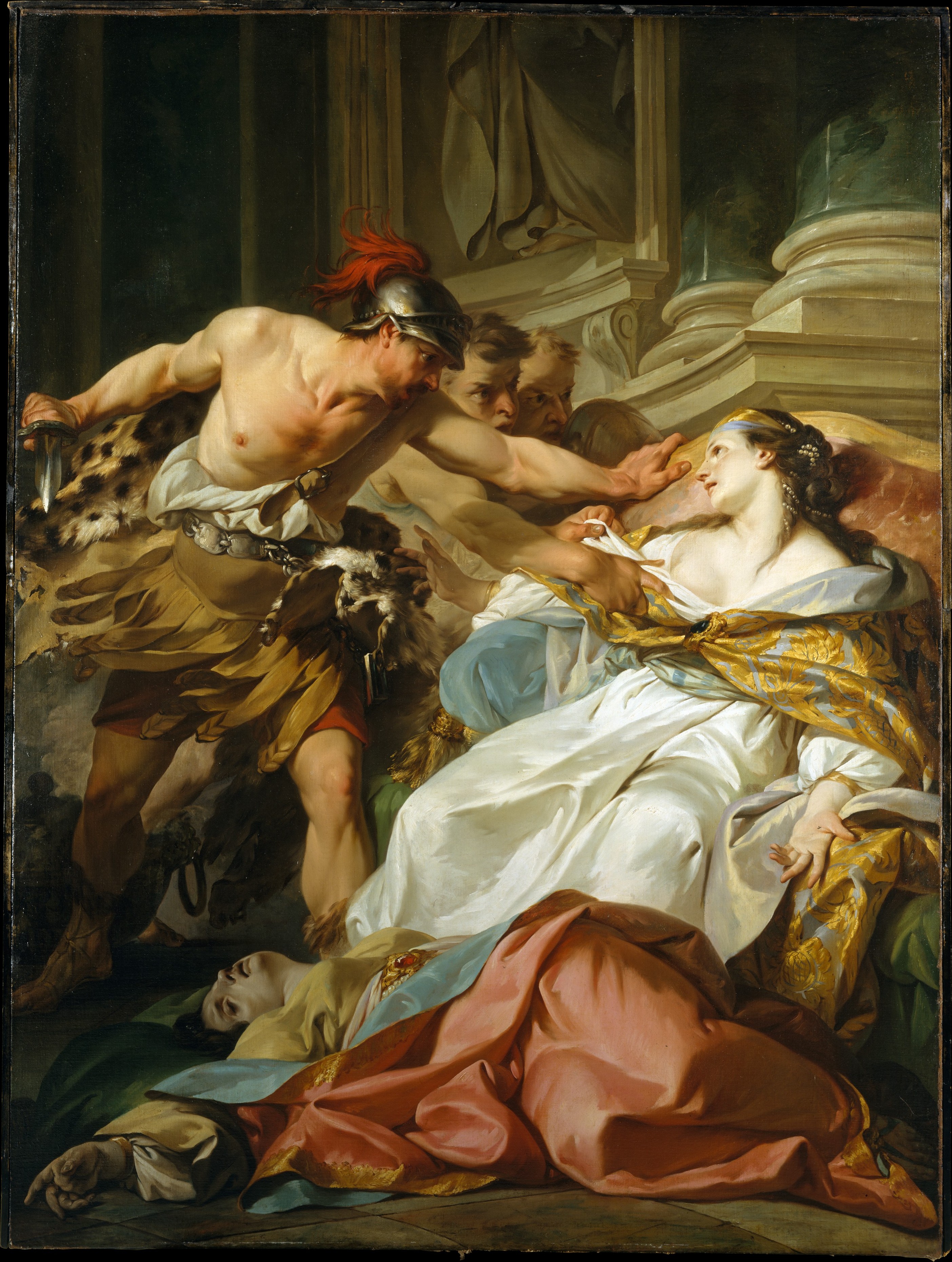
ArtistJean-Baptiste Marie Pierre (French, Paris 1714–1789 Paris)
Title The Death of Harmonia
MediumOil on canvas
Dimensions :  77 1/2 x 58 1/4 in. (196.9 x 148 cm)
Date : ca. 1740–41

Jean wanted to bear witness to the death of Harmonia, the daughter of King Gelon II of Syracuse and her bravery.This painting depicts that the Princess Harmonia risked her death at the hands of the conspirators who had already killed other members of her family. Her governess tried to save her by exchanging her clothes with the princess as she dressed herself in the princess clothes. So, she was murdered in her place. However, instead of escaping, moved by the governess courage, Princess Harmonia reveals her identity and was assassinated. In this painting, the slave woman's dead body was lying near her feet. The assassin were grasping their dagger violently that will eventually cause the death of Princess Harmonia. 

The Painting was drawn realistically. The white draperies worn by Princess on the armchair depicts the young greek and roman women in 214 B.C. In addition, the dead body of the governess was drawn realistically with her discolored face, eyes closed and lying lifeless at the feet of Princess Harmonia. The princess was drawn very large which helps us to emphasis on the courage, bravery she had while facing her assassins. Also, the anger in the eyes of the soldier, with their daggers out as they were going to kill Princess Harmonia. 


The oil on the canvas with different colors helped to depict the paintings more realistically.


The reason i chose this art work is because i felt the strong sense of women's courage in this painting. The Courage of the governess to protect her Princess Harmonia despite knowing that she will die in her place. In addition, Princess Harmonia's courage to reveal her identity while facing the assassins which led to her death.


ART#2


TitleMother and Child
Artist : Kitagawa Utamaro (Japanese, 1753?–1806)
PeriodEdo period (1615–1868)
MediumPolychrome woodblock print; ink and color on paper
DimensionsH. 14 5/8 in. (37.1 cm); W. 10 in. (25.4 cm)
ClassificationPrints
Dateca. 1793
CultureJapan

Utamaro wanted to bear witness to the Multiple activities done by the both mother(a geisha) and the child. In Japan, during the Edo period, geisha became a part of the japanese culture. This print depicts the mother fixing her coiffure infront of the mirror as well as breastfeeding her child who is sucking his mothers nipple, pinches her other nipple with his hand while trying to reach for the toy that is offered by the other women at the back. 

The artist communicate this story visually by the polychrome woodblock print with the ink and the color on the paper. The colors and the ink shows the makeup of the women which indicates that she is a mother who is working as a geisha . The gazes and the gestures depicts the humor of the image.

The work was made with polychrome woodblock print using ink and color on the paper. 

The materials and the manner in which the woodblock print, the ink , the paper used has helped to preserve the color of the print very well.

 The reason i chose this artwork is because i felt that behind the humor of the artist, he is trying to depict the struggle of the japanese woman/mothers to make a living so that she could feed her child and families. In contrary, a mother is someone who has to nurture her baby all throughout the day but instead to have her child a better future, she works as a geisha where she does not even have the enough time to breastfeed her child properly. Leaving the child while she goes to work. 


ART#3


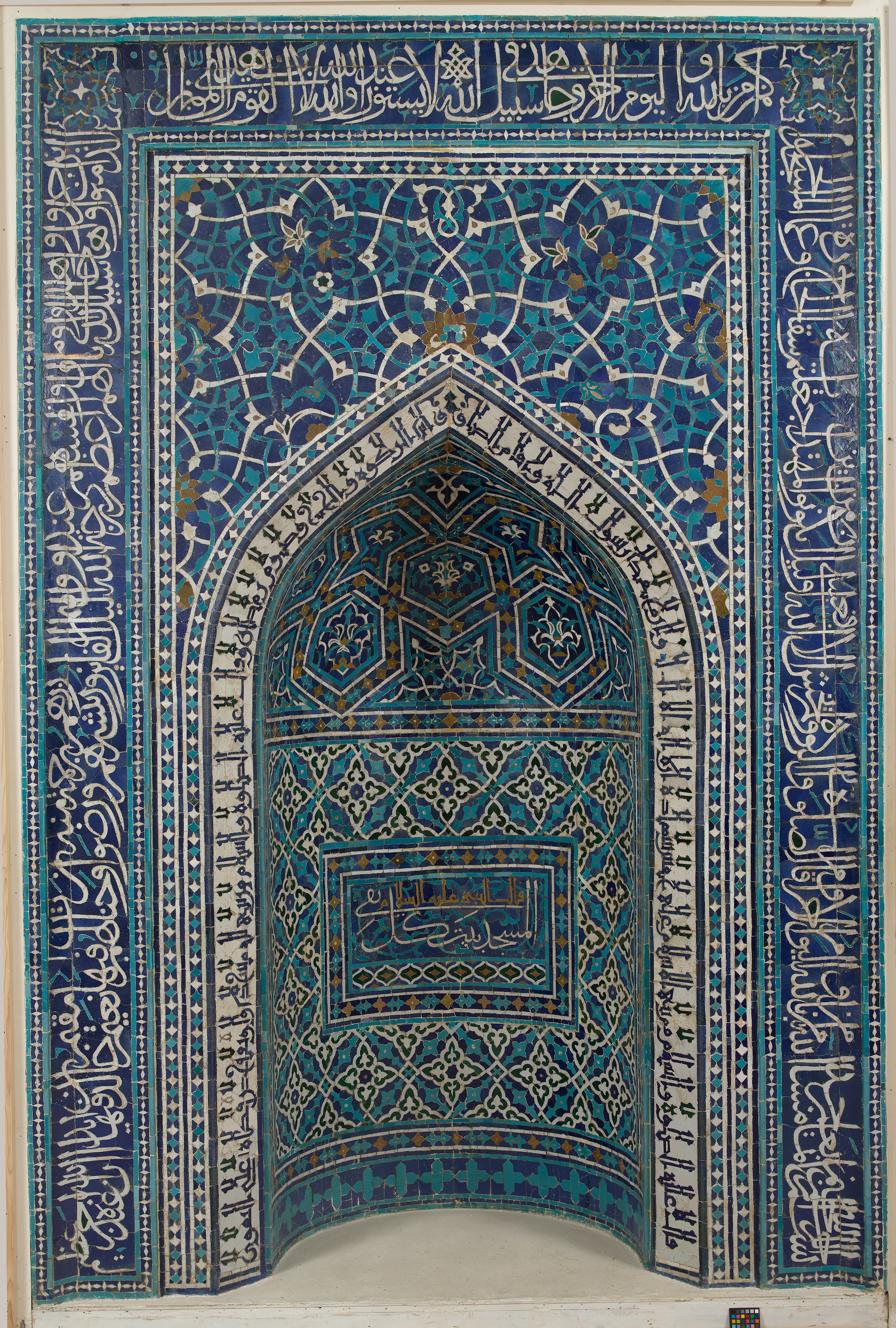
Title: Mihrab (Prayer Niche)

Object Name:Mihrab

Date:A.H. 755/A.D. 1354–55

Geography:Iran, Isfahan

Culture:Islamic

Medium:Mosaic of polychrome-glazed cut tiles on stonepaste body; set into mortar

Classification:Ceramics

Dimensions:135 1/16 x 113 11/16in. (343.1 x 288.7cm) Storage box: 99 x 41 1/2 in. (251.5 x 105.4 cm) Wt. 4,500 lbs. (2041.2 kg)


The work is bearing witness to the prayer niche built by the Islamic people on the Quibla wall of a  theological school in Isfahan, now known as the Madrasa Imami, built just after the collapse of the Ilkhanid dynasty. This is also one of the finest mosaic tilework with the religious inscriptions on it.  It is one of the most significant religious architectural decoration. 

The architect built the tilework with details, colors, used ceramics, glazing on the mosiac tilework. It also has religious inscriptions in Arabic in kufic script framing the niche. 

The work was made with so much details as they need to put up the mosaic of polychrome-glazed cut tiles on the stonepaste body and set in mortor which takes many days to complete it.

The arabic inscriptions on the mihrab and the way the prayer was built depicts the religious architectural decoration. Such decorations helps us to be awe of the detailed work they put to create this beautiful wall. The inscriptions in Arabic in kufic and thuluth scripts at center of niche says 
قال النبي علیه الصلوة والسلام/ المسجد بیت کل تقي  means 
The Prophet, blessings and peace be upon him, said: 
“The mosque is the abode of the pious.” Though i do not understand the inscriptions but it was written beautifully.

I chose this art work because i felt that the mihrab was built beautifully as well as it shows an religious background with the inscriptions on it. The mihrab is futher stating the believe of the islamic people who believes in prophet Muhammed, the messenger of god who said that whoever built a mosque for god, even the smallest size will be given a palace built by the god in the paradise for him. 

Friday, March 7, 2014

ABOUT ME

What makes me interesting...

I am a Tibetan born in India and came to new york five years ago. When people ask me "Where you from?" I respond to them "I am from India". They look at me baffled because i don't look Indian so i explain it to them I am a Tibetan who was born and raised in India. I like to stay home and watch movies during my leisure hours. I am not very active on social networking. I don't have a twitter, instagram but I do have facebook which I visit once a month or less. I used to love social networking when i first came here. I was going on my facebook everyday, posting pictures but after a year i got tired of it. So, now I am not a very active user. I do go out sometimes when I have to meet up with my friends. I am very sensitive when it to comes to my family and friends. My family is my world to me. I have a two younger sister who I am very protective about that sometimes we get into fights as I can be very controlling at times. 

I want to bear witness to.....

If there is one thing i want to bear witness to is the independence of Tibet. It has been almost 55 years since we were conquered by the Chinese government in March 10, 1959. But there was never any progress between the relationship between Chinese and the Tibetan. They continue to deny our independence and threat other countries like United States who are trying to help us. In addition, the Chinese government disapprove the visit of His Holiness the Dalai Lama with Barack Obama in 2010, 2011 and 2014 respectively. They warned the president that this could damage the ties between China and United States. They also stated that the United States should not interfere with the internal affairs of China. However President Obama still met with him. However, after the visitations, nothing really changed. The exploitation of human rights in Tibet are not getting any better. Many Tibetans are still dying from the brutalities of Chinese government. The Beijing Crackdown in 2008 which led to Tibet's unrests resulted in 140 casualties and around 2,300 Tibetans were arrested. In addition the Chinese government had blocked off all the supply of water, electricity, food and health facilities in the active area of riot. Many Tibetans died. Still to this day, the Tibetans living in Tibet are being brutally killed in Tibet yet the United Nations are doing nothing despite all the petition we signed for them because Chinese government are becoming very powerful. I wish before I die I could bear witness to a "Free Tibet" and all Tibetans marching back to Tibet with our national flags and singing our national anthem.