
2. Give your best guess as to the audience of each work.
3. Describe what ideas each work it attempting to bear witness to.
5. Do you think either of the artists knew about the others' art-making tradition? Why?
6. Do you think the mainstream (European) work deserves its place in the mainstream story of art? Why?
7. Do you think the non-mainstream (non-European) work deserves a place in the mainstream story? Why?
ART WORK#1

1. The Abduction of Rebecca(1846)
Artist: Eugène Delacroix(French, Charenton-Saint-Maurice 1798–1863 Paris)
This painting shows a scene from Ivanhoe, the Jewish heroine Rebecca, who was confined in the castle of Front de Boeuf(seen in flames) is carried off by two Saracen slaves commanded by the Christian Knight Bois-Guilbert. This painting depicts the crowded space, the alertness on the slaves and the contortion depicts the dramatic intensity of the abduction. In contrary, Rebecca is the only one in the whole painting that is calm and composed.
2. The audience of the first painting would be for the European people specifically the french people as this could be more relatable to them.
3. This painting is bearing witness to the abduction of Rebecca and her courage.
4. Delacroix is representing the beauty of the painting through the different colors,movements that showed the complexity and the emotions of this art.
5. I don't think that Delacroix knew of Shaykh Muhammad Amir as they live in different parts of the world and also Delacroix is a romantic artist. He was an impressionist who was inspired by Shakespeare and other french romantic artist.
3. This painting is bearing witness to the abduction of Rebecca and her courage.
4. Delacroix is representing the beauty of the painting through the different colors,movements that showed the complexity and the emotions of this art.
5. I don't think that Delacroix knew of Shaykh Muhammad Amir as they live in different parts of the world and also Delacroix is a romantic artist. He was an impressionist who was inspired by Shakespeare and other french romantic artist.
6. I think European Art deserves its place in the mainstream story of Art because these artwork were made in different periods with different style in different places and some artwork, though were made in same period but have different styles. The variety, evolution of these artwork gives us an knowledge on the abstractness and the expression of these artwork.
ART WORK#2
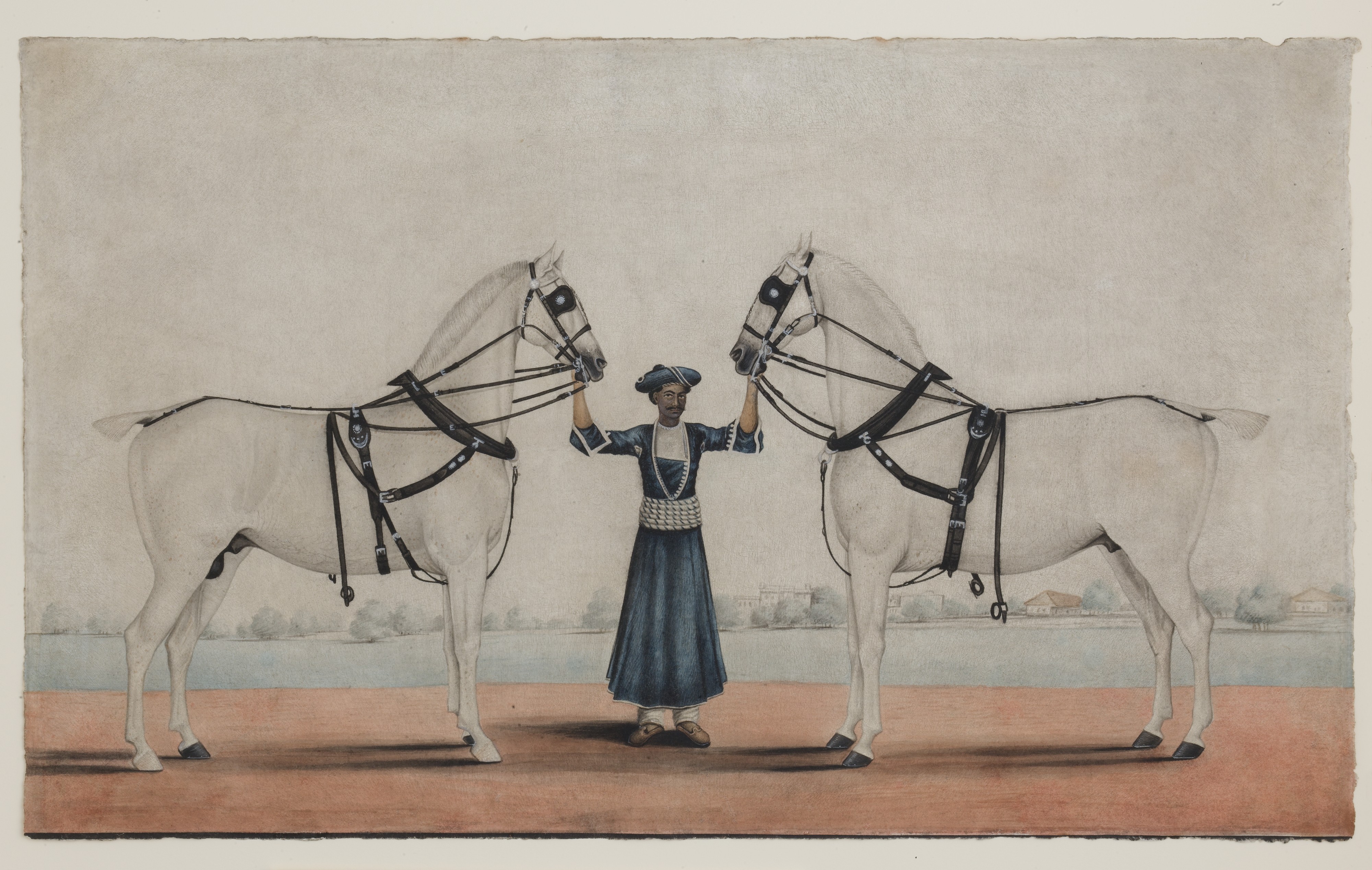
1. A Syce Holding Two Carriage Horses (1845)
Painting attributed to Shaykh Muhammad Amir of Karraya (active 1830s–40s)
This a near mirror image of an Indian groom with almost identical horses. The prospect of symmetry is provoked by the slight difference in the sizes, proportions and the slight variation in the dress and the posture of the painting. The colors are very restricted in the painting but however, the painting was beautifully drawn to show the culture of Indian also the low horizon line makes the painting more majestic.
2. The audience of the painting would be the South Asian people specifically the Indian
people.
people.
3. The artist is attempting to bear witness to the Indian culture as well as the symmetry of
the painting.
4. Amir's representation of the beauty of this painting is very different from Delacroix as he is trying to depict the simplicity of the painting with just few colors of the paint as well as the almost symmetrical image of the Indian groom and the horses.
5. Amir probably was aware of Delacroix art-making tradition as his art making process reflects the Indian culture of free expression as well as the water color style which is massively influenced by the European Art.
6. I think non-European work deserves a place in the mainstream story as these artwork also depicts the different forms of art in different periods and their cultures. Such culture and the beauty of the non-European Artwork must be appreciated and celebrated the same way an European art work is.

Good response. I think in this case, both artists would have been aware of each other's art tradition, if not the other artist individually. Delacroix spent alot of time traveling in the Middle East, and I think Mughal Indian art was well-known in France at the time.
ReplyDeleteYou are right to say that European art influenced Indian painting of the period, and obviously the Indian tastes of the period lean more towards and intellectual, classical beauty than, while the Romantic European art is more "baroque". Great choices in the horse pieces. the two versions of horses couldn't be handled more differently. If someone on an alien world who had never seen a real horse was beamed these two pictures, I doubt they would know that it is the same type of animal in both paintings!
(A)